
News

How to Choose the Right Compression Spring
1. Spring Material
Stainless Steel (SUS304, SUS301, SUS316, SUS631): Corrosion-resistant, suitable for outdoor or humid environments.
Music Wire (SWC): High tensile strength, commonly used for general industrial applications.
Oil-Tempered Wire (Silicon-Chrome Alloy Steel): Excellent elasticity, fatigue resistance, and wear resistance; ideal for heavy-load springs.
Phosphor Bronze / Beryllium Copper: Excellent electrical conductivity, suitable for electronic devices.
Special Alloys (e.g., Inconel, Hastelloy): Suitable for high-temperature and highly corrosive environments.
2. Wire Diameter and Outer Diameter
Affect spring stiffness and load capacity.
The thicker the wire, the higher the spring stiffness.
3. Free Length and Compression Stroke
Free length should be determined based on the required compression range in the application.
Ensure sufficient travel to avoid excessive compression, which may cause permanent deformation.
4. Number of Coils and Coil Pitch
Influence overall elasticity and deformation behavior.
For longer travel requirements, a higher number of coils is recommended to increase flexibility.
5. Maximum Working Load and Compression Height
Ensure that the stress under maximum compression does not exceed the material’s allowable limit to prevent failure.
6. Installation Space Constraints
Confirm that the spring has adequate room to compress and expand during assembly.
Consider guide mechanisms to prevent buckling or misalignment during operation.
7. Operating Environment
For high temperature, corrosive, oily, or humid environments, choose appropriate materials and surface treatments (e.g., zinc plating, black oxide, rust preventive oil).
Various Retaining Rings – Shaft Applications
A shaft retaining ring is a type of fastener installed into a groove on the outside of a shaft to position or secure components and prevent axial movement. Depending on the structure and application, common types include:
E-rings: Easy to install, commonly used on small-diameter shafts.
S-type Snap Rings: Feature an open-ended design for installation into shaft grooves.
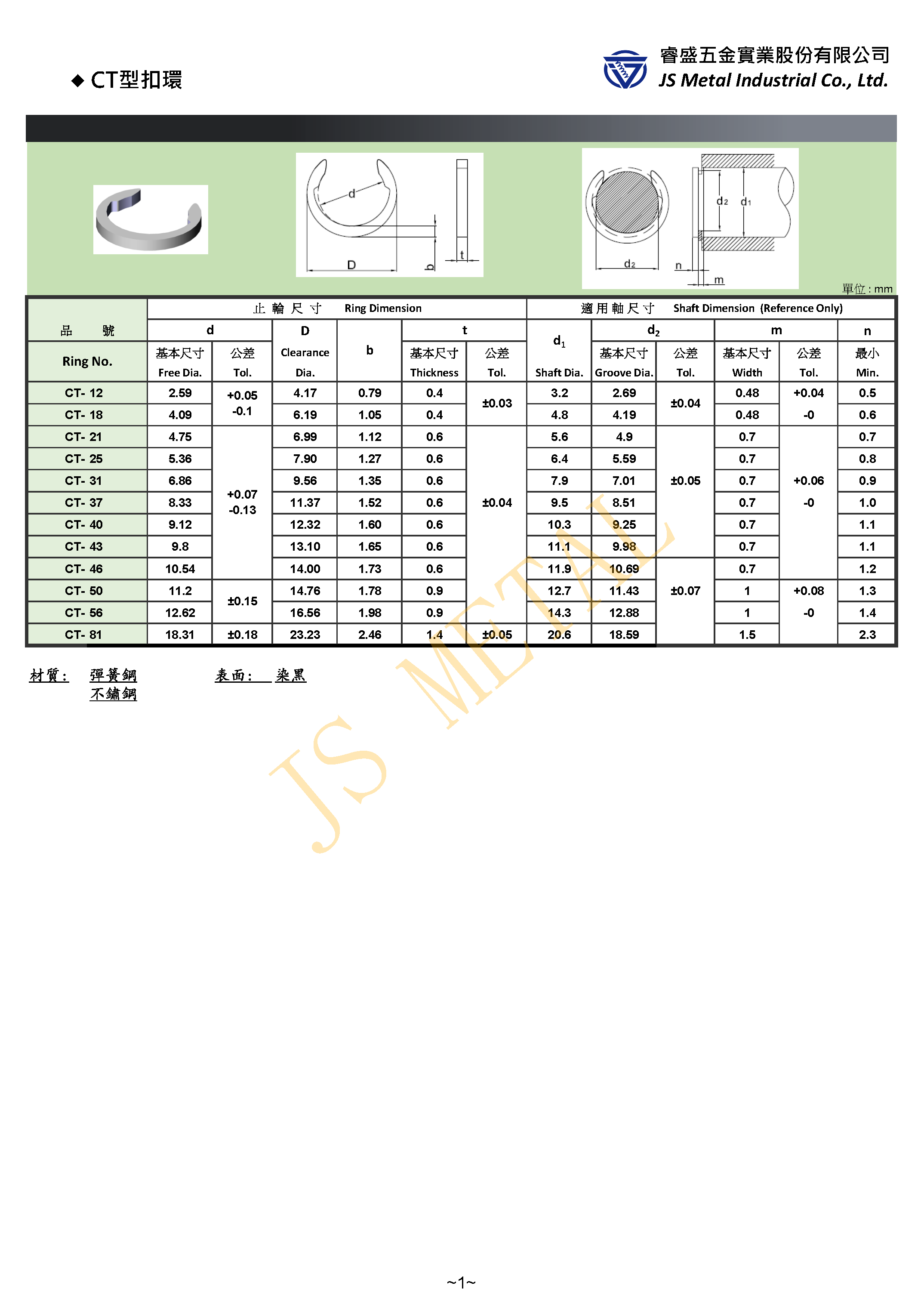
CT-type Retaining Rings: Structurally robust, suitable for heavy-load or high-speed applications.
Constant Section Rings: Uniform cross-section provides consistent and reliable retention force.
IR Series Internal Retaining Rings (Housing)
The IR Series Internal Retaining Rings (Housing) is a type of retaining fastener installed in a groove inside a bore. It is used to secure components and prevent them from moving axially. The "IR" designation stands for "Internal Retaining ring", specifically designed for positioning within internal bores.
IR Series Internal Retaining Rings (Housing) are installed into internal grooves of components and are mainly used to prevent axial movement. They are commonly found in various machinery, automotive applications, and electronic equipment.
S Series External Retaining Rings (Shaft)
S Series External Retaining Rings (Shaft) is a mechanical fastener installed in a groove on a shaft to hold components in place and prevent axial movement. It features a simple “S” shape, offering ease of installation and reliable performance, especially suitable for small to medium shaft diameters.
C-type Retaining Ring /Shaft Retaining Ring/Retaining Ring
A C-type external retaining ring is a mechanical fastener used on shafts. Shaped like an incomplete ring (similar to the letter "C"), it fits into a groove on the shaft to prevent axial movement of components such as bearings, gears, or pulleys.
Prevents axial movement: Keeps mechanical components in position, ensuring operational accuracy and stability.
Common applications: Gearboxes, motors, bearing housings, bicycles, automotive parts, machine tools, robotic arms.
Quick installation and removal: Compared to screws or nuts, circlips are faster and easier to install or remove.
Types of C-type Retaining Rings and Descriptions:
Shaft type (External Circlip): Installed on the outside of a shaft, snapping into a shaft groove.
Hole type (Internal Circlip): Installed inside a bore, expanding to fit into a groove on the inner wall of the hole.
What is a Single Torsion Spring /Single Coil Torsion Spring / Single Direction Torsion Spring
A single torsion spring, also known as a single-coil torsion spring, is a type of helical spring that generates a counteracting torque when its two ends are twisted. Once the external force is removed, the spring returns to its original shape. It is one of the most basic types of torsion springs.
A single torsion spring uses torsional deformation to generate torque (rotational force). It is usually in a helical shape, with both ends extending into spring legs (also called spring arms). When these legs are twisted or rotated, the spring stores energy, and once the force is released, it returns to its original position.
E-Type Retaining Ring – ETW
The E-Type Retaining Ring, commonly referred to as the E-Ring, is a widely used mechanical fastener designed to secure components onto a shaft and prevent axial movement. Shaped like the letter "E," it features three internal prongs that tightly snap into a groove on the shaft. E-Rings are commonly applied for shaft positioning, securing parts, and preventing axial sliding.
Wave Spring Selection
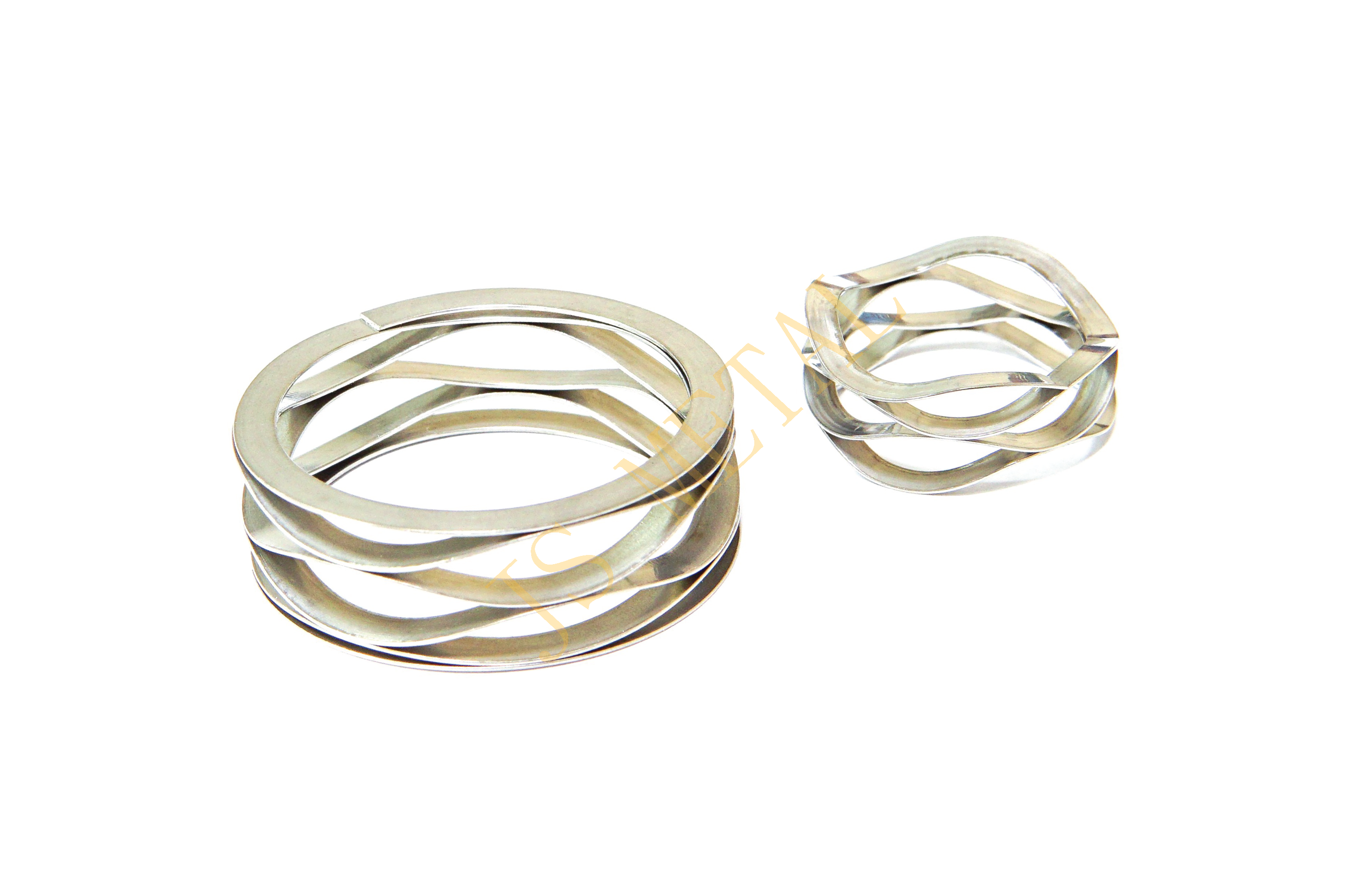
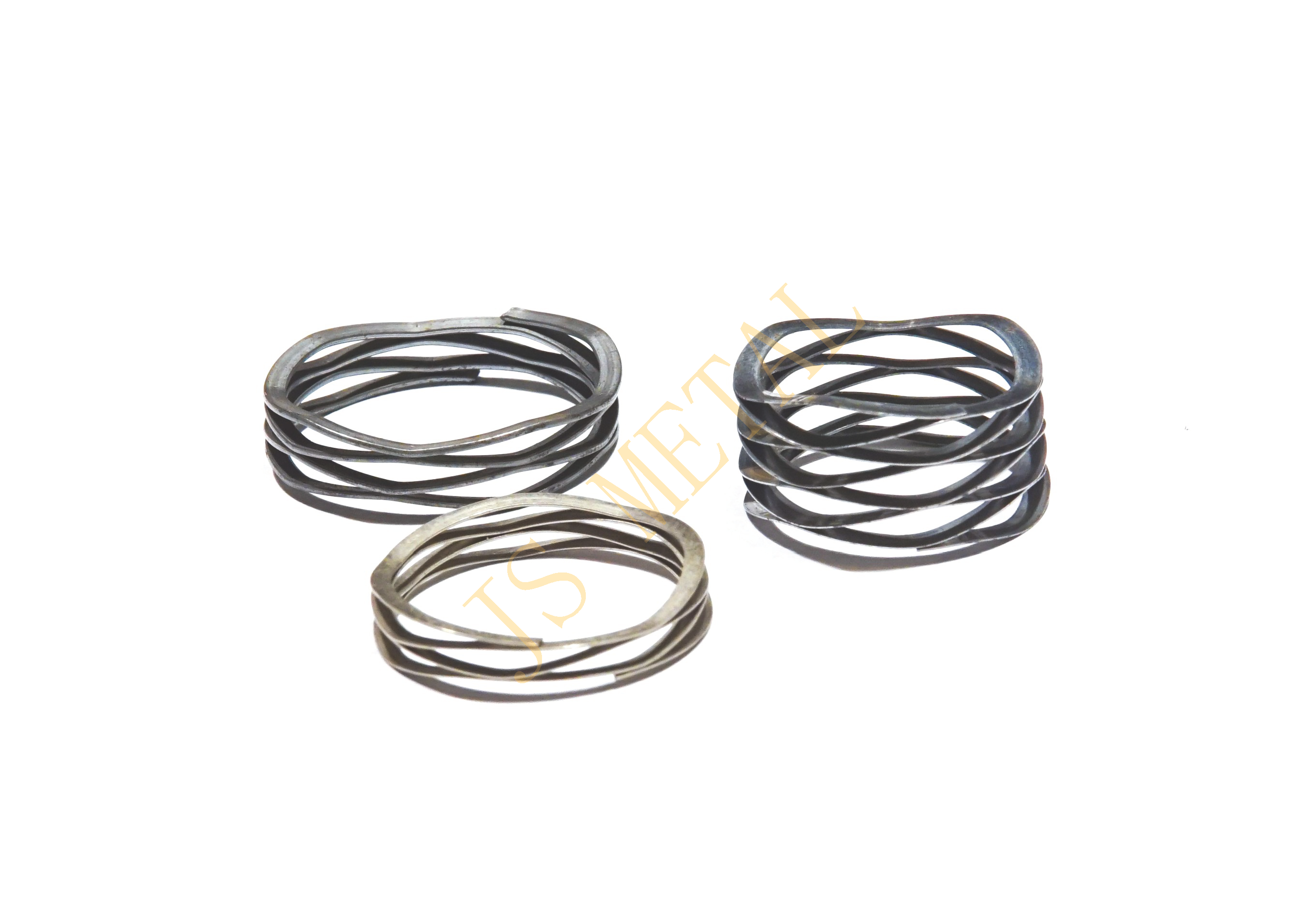
Wave Spring is a type of flat spring made from coiled metal strip with a wave-like shape. It primarily relies on the elasticity of the metal material and its wave structure to provide compressive or supportive force. Compared to traditional coil compression springs, wave springs are more compact and space-saving.
A wave spring is a flat metal spring with a wavy outer contour. It is formed by bending a flat wire into one or more turns of wave shapes, and is mainly used to provide compressive force.
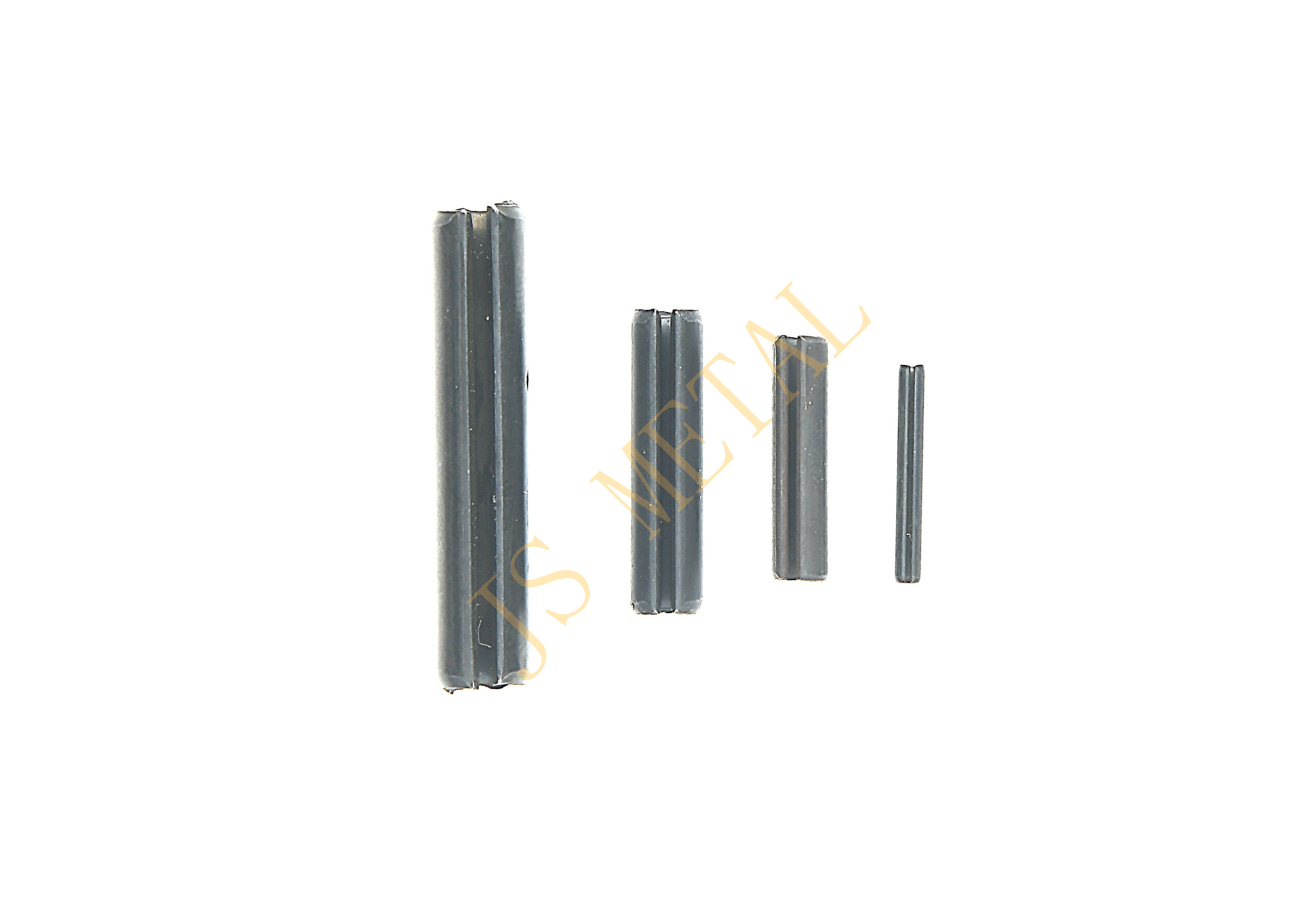
Spring Pin
An SPP-Type Spring Pin is a flexible fastening and positioning component commonly used to connect and secure parts in mechanical systems, equipment, or assemblies. It features a hollow cylindrical body with a special slit design that allows it to expand slightly when inserted into a hole, creating outward pressure to ensure a secure fit and prevent loosening.
Key features of SPP-Type Spring Pins:
Easy to install, with no need for threads or additional fasteners.
Elasticity allows for shock absorption and tolerance of slight movements.
Reusable and resistant to damage during assembly/disassembly.
Widely used in automotive, electronics, and industrial precision machinery.
Spring Selection – Extension / Compression / Torsion Springs
When selecting a spring, factors such as application, load direction, space limitations, and working environment are considered to determine the appropriate type, material, dimensions, and surface treatment. Examples include compression springs, extension springs, torsion springs, spiral springs, wave springs, and wire forms.
The selection of the suitable spring is based on the actual application needs of the customer. With our professional experience, we analyze and design optimal solutions to provide recommendations that ensure maximum performance.
Compression Springs: Introduction and Applications
A compression spring is one of the most common types of mechanical springs, made by coiling round or square metal wire into a helical shape. It stores mechanical energy when subjected to a compressive force and returns to its original shape when the force is removed. The force exerted by a compression spring is directly proportional to its compression distance, making it ideal for providing restorative force or absorbing shocks.
A compression spring, also known as a coil spring, is a type of spring that stores mechanical energy when compressed. Once the external force is removed, the spring returns to its original shape, releasing the stored energy. As one of the most widely used spring types, compression springs are extensively applied in machinery, electronics, automobiles, and various other fields.
Compression springs are typically formed using round or square wire, coiled into a helical shape. The spring ends can be designed as closed or open, depending on the application. Based on the requirements, compression springs can provide either linear or non-linear restorative forces.
Introduction to Wave Springs
A wave spring is a thin metal spring with a wavy, wave-like shape. Compared to traditional coil springs, it offers the same elastic functionality with a more compact design. Wave springs are typically used in applications where space is limited, and precise force control is required.
Due to their compact structure and high elastic deformation capability, wave springs are particularly suitable for applications that demand accurate load control and reduced space usage.
Tension Spring - Tension Spring Factory - Custom Tension Springs
Customization of Tension Springs
Due to the diverse range of applications for tension springs, the specifications required for each use can vary greatly. Tension spring manufacturers typically offer customization services, allowing them to design and produce springs that meet specific customer requirements.
We specialize in manufacturing various types of tension springs. A tension spring—commonly referred to as an extension spring—is designed to undergo elastic deformation when stretched, storing mechanical energy in the process. Once the external force is removed, the spring returns to its original shape, releasing the stored energy. This elastic property makes tension springs widely applicable in industries such as manufacturing, machinery, and electronics.
Tension Springs | Extension Springs | German Hook Type
Tension Springs, also known as Extension Springs, are a type of spring that undergoes elastic deformation when subjected to tension, storing energy in the process. Once the external force is removed, the spring returns to its original shape, releasing the stored energy. This elastic property makes tension springs widely used in industries such as manufacturing, machinery, and electronics.
Tension springs typically have a spiral shape, composed of multiple coils. The diameter of the coils, the number of coils, and the wire diameter determine the spring's force and stroke length.
Compression Spring – Coil Spring – Clip Spring
Compression Springs are a type of spring that undergoes elastic deformation when subjected to compressive force, storing energy in the process. Once the external force is removed, the spring returns to its original shape, releasing the stored energy. This elastic property makes compression springs widely used in industries such as manufacturing, machinery, and electronics.
As a common mechanical component, compression springs play a crucial role in modern industry. By understanding the structure, material, operating principle, and selection methods of compression springs, we can make better choices and use them more effectively, thus improving product performance and reliability.