
News

Wire Form/線性彈簧
Wire forms or linear springs are elastic or structural components made by precisely bending and forming metal wire. They can be custom-designed in various shapes and functions according to customer requirements, and are used for holding, supporting, guiding, transmitting, or returning motion in a wide range of applications.
These products may not necessarily exhibit obvious compression or extension characteristics, but can provide elastic support or restoring motion depending on their design. Wire forms are widely used in automotive components, electronic devices, medical equipment, industrial machinery, hardware fittings, and household appliances.
Different materials can be selected based on design requirements, such as SUS304, SUS316, SWP, piano wire, phosphor bronze, and INCONEL X-750, with optional surface treatments including zinc plating, nickel plating, painting, or passivation to enhance appearance and corrosion resistance.
Magazine Compression Springs/彈夾壓縮彈簧
A magazine compression spring is a type of compression spring used inside a magazine assembly to provide stable and continuous pushing force, ensuring smooth feeding or movement of bullets or components.
These springs are typically made from high-carbon steel wire, piano wire, or stainless steel, offering excellent fatigue resistance and corrosion protection. They can be customized in wire diameter, outer diameter, free length, and number of coils to achieve the desired balance of force and durability.
Torsion Springs/扭力彈簧
A torsion spring is an elastic component that stores energy through the elastic twisting deformation of its material. When an external force is applied to both ends of the spring, causing it to twist, the spring generates a counteracting torque (torsional force) and returns to its original position once the force is released.
Torsion springs are commonly used in clamps, switches, camera shutters, automotive seat mechanisms, door hinges, robotic arms, and various rotating devices.
Their structure is typically made by coiling round wire into a helical shape, with both ends formed into different types of legs. Depending on the application, they can be designed as single or double torsion springs. During the design process, factors such as torque, rotation angle, space limitations, and material properties are carefully optimized to achieve the desired performance.
Compression Springs/壓縮彈簧
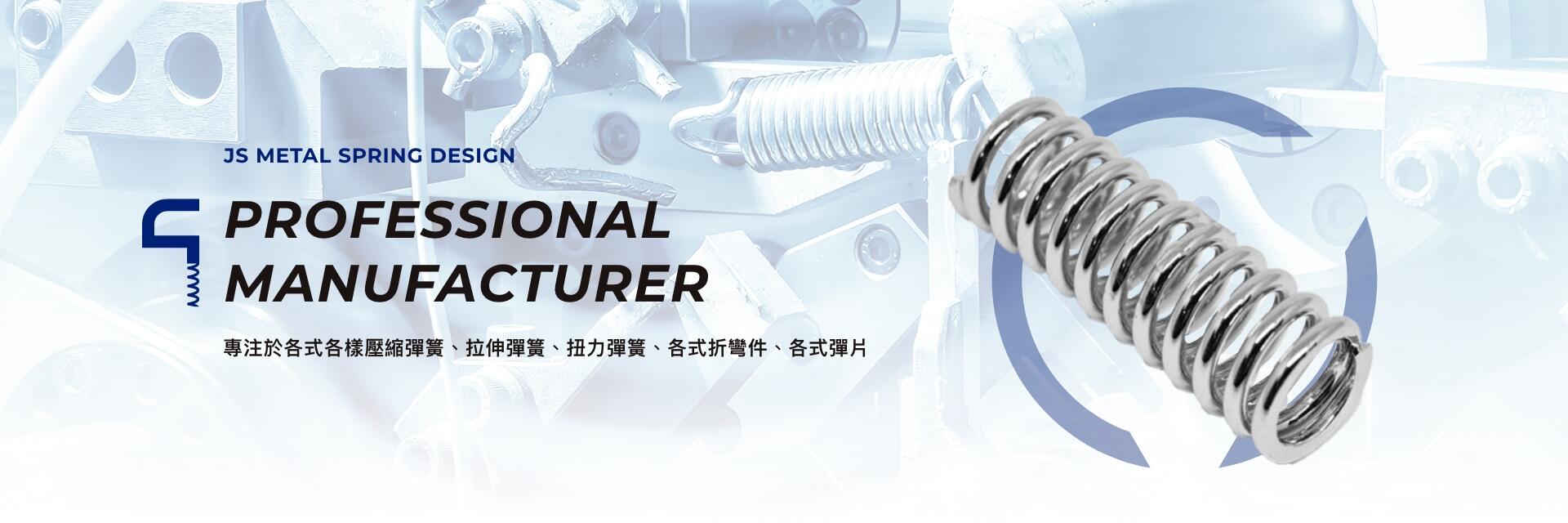
A compression spring is an elastic component that stores energy when compressed and returns to its original shape once the external force is removed. It is one of the most common types of springs and is widely used in various mechanical, electronic, and industrial applications, such as automotive suspension systems, valves, medical devices, household appliances, and electronic equipment.
Compression springs are typically made by coiling round or square wire into a helical shape. Depending on the application, they can be designed in different forms — such as cylindrical, conical, barrel-shaped, or with variable pitch — to meet specific mechanical characteristics and space requirements.
Tension spring/Extension Spring
An extension spring is a helical spring that elongates under tensile load and returns to its original shape when the load is removed. It is typically made of spring steel wire and designed with hooks or loops at both ends for fastening or connecting components.
Extension Springs/Tension Spring
An extension spring is a helical spring that elongates under tensile load and returns to its original shape when the load is removed. It is typically made of spring steel wire and designed with hooks or loops at both ends for fastening or connecting components.
Working Principle: When an external force pulls the two ends apart, the spring extends and stores energy; once the force is released, the spring contracts back to its original length.
Initial Tension: During manufacturing, a certain amount of preload is set so that the spring remains tightly coiled even without external force.
Connection Options: The end configurations of extension springs vary (such as German hooks, English hooks, machine loops, etc.) and can be customized according to specific application requirements.
Spring/What is a spring?
A spring is a mechanical component made of elastic material that deforms under external force and returns to its original shape once the force is removed. Its primary functions are to store and release energy, absorb shock, maintain force, or control motion.
Common types of springs include compression springs, extension springs, torsion springs, bending springs, spring pins, spiral springs, retaining rings, die springs, internal and external tooth washers, and wave springs.
Retaining Ring/E Series External Retaining
An E Series external retaining(Shaft) , also known as a retaining ring , is a common mechanical fastener specifically used for bearing positioning and axial retention. It is typically made of spring steel or stainless steel and is installed into a groove on a shaft or in a bore through elastic deformation, thereby restricting the axial movement of components.
An E Series external retaining(Shaft) is a Shaft Retaining Ring with a“E-Series” profile. It provides elasticity and self-locking capability, making it suitable for installation on shafts or in bores to prevent parts from slipping off. With a simple structure and ease of assembly and disassembly, it is widely used in precision machinery and tools.
Retaining Ring/S Series External Retaining
A S Series external retaining(Shaft) , also known as a retaining ring , is a common mechanical fastener specifically used for bearing positioning and axial retention. It is typically made of spring steel or stainless steel and is installed into a groove on a shaft or in a bore through elastic deformation, thereby restricting the axial movement of components.
A S Series external retaining(Shaft) is a Shaft Retaining Ring with a“S-Series” profile. It provides elasticity and self-locking capability, making it suitable for installation on shafts or in bores to prevent parts from slipping off. With a simple structure and ease of assembly and disassembly, it is widely used in precision machinery and tools.
Spring Pin/Spring Pin(SPP)
Spring Pin (SPP Type Spring Pin) is a commonly used mechanical fastener. It is a cylindrical, thin-walled metal tube with a longitudinal slot, typically made of spring steel or stainless steel. During installation, the slot allows the pin to compress as it is inserted into a hole, and the restoring force of the material ensures a tight fit, providing positioning, fastening, or shear load-bearing functions.
Die Spring/Compression Spring
A die spring is a type of high-strength compression spring specifically designed for dies, stamping machinery, and heavy-load applications. Unlike ordinary compression springs, die springs are often made from rectangular or square wire, allowing them to withstand greater compressive loads within limited installation space. They also feature excellent fatigue resistance and high-temperature durability.
Spring Manufacturer/How to Choose Compression Springs
Compression springs are widely used in automobiles, machinery, electronics, and everyday products. Choosing the right compression spring ensures product performance and durability. Below are the key factors to consider when selecting a compression spring:
1. Load and Force Requirements
Determine the maximum load the spring must withstand under working conditions.
Select an appropriate spring rate (spring constant) according to application needs.
2. Installation Space
Measure the solid height (maximum compressed length) and free length.
Ensure the spring will not be over-compressed or too loose within the available space.
3. Material Selection
Carbon steel wire (SWP): High tensile strength, prone to rust, requires surface treatment.
Stainless steel (SUS304): Corrosion-resistant, suitable for humid or special environments.
Silicon-chrome alloy steel / special materials: Suitable for high-temperature or high-strength applications.
4. Shape and Design
Cylindrical compression spring: Most common, provides uniform load distribution.
Conical compression spring: Prevents spring stacking, improves stability.
Barrel-shaped: Larger middle diameter with smaller ends, ideal for vibration absorption.
Hourglass-shaped: Smaller middle diameter with larger ends, enhances stability in specific applications.
Spring / Compression Spring
A compression spring is one of the most common types of springs, typically helical and made from coiled wire. Its primary function is to store energy when an external force is applied to shorten it, and to release the energy as it returns to its original shape once the force is removed.
Torsion Spring Factory /Spring Manufacturer
1. Capable of manufacturing based on drawings or samples, ideal for machinery manufacturers, product development, and
professional design projects.
2. A professional factory specializing in the production of various springs, including compression springs, extension springs,
and torsion springs.
3. Nearly 50 years of manufacturing experience, ensuring fast delivery and excellent quality.
4. Equipped with complete production facilities and inspection instruments, with fully automated manufacturing processes.
5. Serving industries such as computer hardware, automotive, bicycles, motorcycles, electronics, electrical appliances,
sporting goods, and aerospace.
Spring Factory /Compression Springs
Compression springs are one of the most common types of springs. Typically in a helical shape, they are designed to store energy when compressed and return to their original form upon release. Their primary functions include absorbing external forces, providing elastic force, and restoring components to their original position.
1.Provides return force: Used in mechanisms that require resetting, such as buttons, sliders, and valves.
2.Absorbs impact/vibration: Acts as a buffer to reduce wear and impact on components.
3.Stores energy: Stores potential energy during compression, which is released as kinetic energy when the spring expands.
4.Durable and elastically stable: Capable of enduring tens of thousands to millions of cycles, making them ideal for long-life applications.